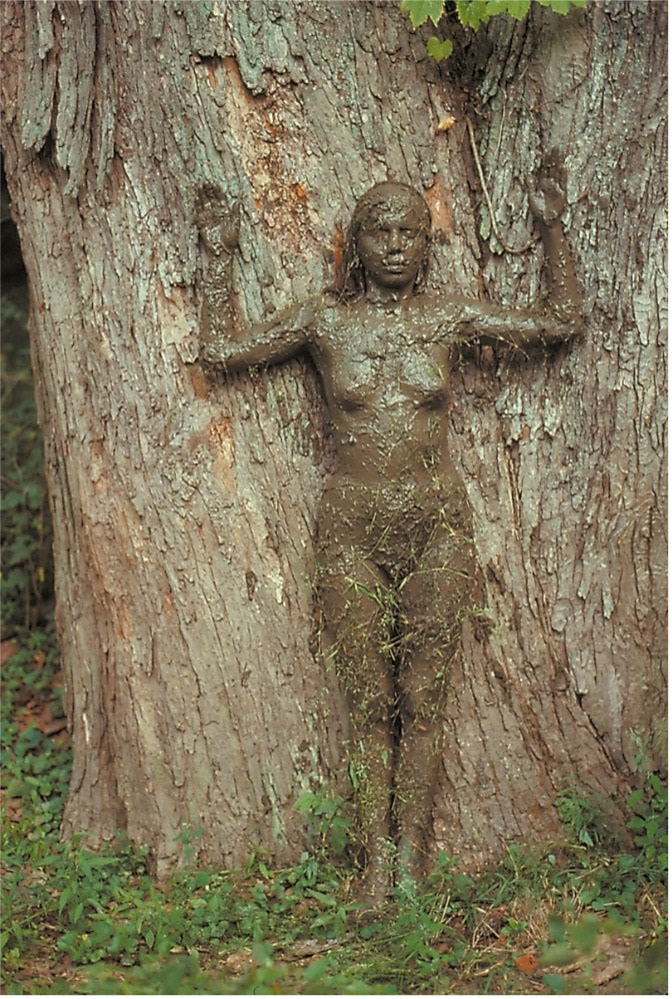
Figure 1: Mendieta, A. (1976)
Arbol de la Vida (Tree of Life), from Silueta series [colour chromogenic print, 50.8 x 33cm]. Collection Raquelín Mendieta Family Trust. MFA, Boston - Accession number: 1992.161
(Copyright courtesy of the Estate of Ana Mendieta and Gallerie Lelong, New York) (Contemporary Curator’s Fund, including funds donated by Barabara and Thomas Lee and an anonymous donation)
From Richard Long’s desire paths to Robert Smithson’s monumental transformations, the most prominent feature of land art is the relationship between the self and the site of the work. Across diverse practices, land artists use the process of intention, selection, iteration, and intervention alongside naturally sourced materials to sculpturally engage with their selected site. However, they often tend to treat the landscape as yet another ‘canvas’. Here the role of the land artist exists within an elusively conceptual plane, as the resulting work within the passive landscape provides little authorship of the artist themselves. Cuban American artist Ana Mendieta innovates the role of the land artist through her visceral interaction with the site. She empowers the female body as an extension of the natural landscapes, using references to the Goddess icon. Contemporary use of Goddess imagery provokes a feminist dialogue, transitioning from the masculine ‘mind body duality’ to a feminine ‘holistic mind body totality’ (Orenstein, 1982 p.158). In her rejection of the masculine duality between the land artist and their passive sculptural object, she instead favours intense performances within the landscape in which she explores her role as a female subject.
Following minimalism and conceptual art movements, land art aims to moves away from the interior gallery environment and challenges the former authority of the artist and art object. Instances of fine arts can oftentimes fall prey to becoming inaccessibly conceptual with a lost focus on the experience and value of artistic processes (Dewey, 1934). Criticisms of minimalism in particular note its inappropriate degree of emphasis on the authority of the object and its existence within the space (Fried, 1967). In response, the land artist rejects these notions by using naturally sourced materials and processes that are presented beyond the gallery wall.
Despite this sentiment, prolific variations of early land artworks are unable to entirely abandon the principles of their preceding movements. In light of sculpturally minimalist techniques, scaling earthworks are visually similar in their use of large, basic forms with a consideration for space. When discussing minimalist sculpture, there is a commanding relationship between a work’s scale and the hand crafting it (Andre, 1970). In light of this, early earthworks begin to command a masculine perception in their colossal, simplified shapes that penetrate and cut into the landscape. The work treats the landscape as a subordinate material that can be carved, detonated and permanently intervened in through mechanical processes. In this process, the invisible, omnipotent land artist becomes sculpturally destructive in the landscape, producing simplified forms that are visually mimetic of earlier minimal outcomes.
Mendieta’s work is therefore necessarily innovative in its distancing from large-scale, masculine, and permanent interventions. Pushing boundaries towards processes of performance and body art, Mendieta’s land art is ephemeral; her performances are made permanent only by photography that captures ‘the spirit of the art’ (Mendieta, 1981 pg.70). Her organic approach to land art effectively mirrors the transient nature of the material natural world. Rather than echoing minimalism, Mendieta’s focus on intentional interactions with the site are experience and process driven. (Blocker, 1999 p. 5). They provide a feminine perspective to land art through her employed unity with the landscape, drawing on wider concepts such as Mother Nature and the divine Goddess. She becomes integrated in the material and process, rather than establishing a duality between herself and the landscape. Her work involves the viewer beyond spectatorship of an unmoving, refined sculpture that has been cut into the landscape. Instead, Mendieta presents work that is evidence of process-led performance, documented through both photography and video (Blocker, 1999 p.5).
Specifically, in a still from ‘Arbol de la Vida’ (Tree of Life ) [fig. 1] Mendieta demonstrates her innovative, intuitive interaction with the site. In the image, her nude body is stood at the base of a large tree. Both the foreground and background are unified through their textures; Mendieta is doused with a combination of mud, grass, and bark. Central in the composition, her body is symmetrically posed with arms bent above her head and eyes closed. Her posture is upright and strong, strengthening the image’s linear composition whilst also appearing structurally mimetic of the tree trunk. Employing these methods of unity alongside a lack of negative space, the contrast between Mendieta and the tree is harder to establish. Consequentially, an intentional similitude between the two forms is established.
By blurring these boundaries, Mendieta employs a subjective presentation of her body. In her textural similitude to the landscape, she engages in a cathartic release of her individual identity (Ultan, 2001 p. 30). She transcends the role of land artist, instead becoming a self-inflicted subject within the site of the work. Her linear, surrendering gesture openly exposes her body to weathering from the elements. It also demonstrates a representational similarity to the linear structure strength of the tree (Blocker, 1999 pg. 61). Through this process of reduction and representation, Mendieta challenges the authority of the previously omnipotent land artist and the assumption of a subordinate ‘material’ landscape. The authority of the artist has been abandoned and is instead made equal to the material site.
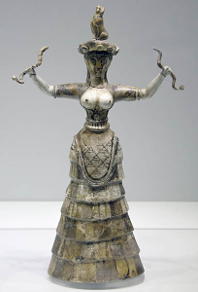
Figure 2:
Snake Goddess artifact (1600 BC) [glazed ceramic, 29.5cm]
Palace at Knossos, Heraklion Archaeological Museum
(photo: Kde)
When considering her nudity and subjecthood within the work, Mendieta’s role as land artist engages in wider feminist discussions concerning the treatment of not just the landscape as subordinate, but the female body. Historically, the inclusion of the female nude would indicate it as a pleasurable spectacle at the hand of male artists, through the lens of the male gaze (Berger, 1972 pg. 51). Additionally, her reference to the Biblical Tree of Life encourages concepts surrounding a source to Eve’s disobedience of God causing ‘original sin’, as well as shame concerning nudity within the Garden of Eden. Both these factors contribute to a shameful female perspective considering their own nudity at the hands of a higher male power. A rise in influential ecofeminist texts and spiritual feminist artwork during the 1970’s challenged this existing patriarchal power of Church and the objectified perspectives on the female. Most profoundly, ecofeminist Daly’s (1973) criticism of the anthropomorphism of a male God challenged the elevation of men over women and called for a return to the spiritual origins of the Earth.
Mendieta’s conceptual representation of the Goddess icon within ‘Arbol de la Vida’ is therefore contextualised as an attempt to subvert these patriarchally charged attempts a female subordination. The Goddess icon denotes themes of transformation and a reclamation of the female body, with some examples alluding to the Minoan Snake Goddess (Orenstein, 1982). With reference to a historical Minoan artifact [fig. 2], Mendieta’s pose echoes this outstretched, wide, open reach. Use of this allusion by contemporary feminist artists simulates the Goddess as a wider consciousness that is inherently within the feminine (Orenstein, 1982 pg. 162). These spiritual concepts present Mendieta’s role within her land art as a communicator of the interconnecting forces between woman, Earth and the divine. For Mendieta, these forces are inherently engaged with one another under the everlasting force of the Earth itself (Blocker, 1999 pg. 61).
Furthermore, the use of spiritual ritual by contemporary feminist artists attempted to ‘resacrilse’ the female body (Orenstein, 1982 pg. 161). Mendieta therefore empowers the female nude beyond an object of male spectacle or Biblical shame through her ritualistic transformation within the site. Mendieta’s voluntary nudity is not a sexual spectacle but instead made divine through her reclamation of the female subject. She affirms a political dimension to her land art, using it as a mode of purging for female nude beyond a passive subject of patriarchy and the male gaze. Instead, the female nude is empowered as an autonomous feature of the work that is united with the power and presence of the natural landscape.
The spiritually meditative process of Mendieta’s land art ultimately transforms the role of the land artist through its deconstruction of the boundaries between artist and material. For Mendieta, the landscape is not subordinate or passive, but rather coexists alongside her; both the Earth and Mendieta herself are transient features of her ephemeral earthworks. She extends her challenge of the authority of the artist and art object beyond to wider feminist discussions. Primarily concerning female bodily autonomy and the politics of the female nude, Mendieta creates space for work that is eternally empowering. Mendieta’s land artist is inherently organic, spiritually divine, and innovatively transformative.
Bibliography:
Andre, C (1970) ‘An Interview with Carl Andre’ Interview by Tuchman, P, Artforum, Summer 1970, Vol. 8 No. 10.
Berger, J (1972) Ways of Seeing. London: Penguin Books Ltd.
Blocker, J (1999) Where is Ana Mendieta? Durham and London: Duke University Press.
Daly, M. (1973) Beyond God the Father Toward a Philosophy of Women’s Liberation. Boston: Beacon Press.
Dewey, J (1934) Art as Experience. New York: Perigee Books.
Fried, M. (1967) ‘Art and Objecthood’ in Harrison, C and Wood, P (eds.) Art in Theory 1900-2000. An Anthology of Changing Ideas. USA: Blackwell Publishing, pp. 835-846.
Mendieta, A (1988) ‘A Selection of Statements and Notes’, Sulfur, Spring 1988, p 70.
Orenstien, G.F. (1982) ‘The Reemergence of the Archetype of the Great Goddess in Art by Contemporary Women’ in Robinson, H (eds.) Visibly Female Feminism and Art: An Anthology. London: Camden Press, pp. 158-170.
Ultan, D.K (2001) ‘From the Personal to the Transpersonal: Self Reclamation Through Ritual-in-Performance’, Journal of the Art Libraries Society of North America, Vol. 20, No.2 Autumn 2001, pp. 30-36